Represent Angel Graphic Tee Review: A Five-Line Agent Note for a $7.76 Variant, Tested Start to Finish
We wrote a five-line note before the agent bought this $7.76 crew neck: variant code, size, a measurement request, one photo angle and a packing rule. Three lines earned their place. One did nothing.
Praxistest-Bewertung 4.2 / 5
Redaktionsnote 4.2 / 5
- Veröffentlicht am
- Aktualisiert am
Redaktionsurteil
A roomy combed cotton crew neck that measured and washed predictably for $7.76 — but the brand itself warns the cracked print loses ink, and its sizing reports still conflict.
Für wen geeignet
Beginners willing to write a short agent note and confirm measurements, who want a light, breathable cotton graphic tee and accept that the print will age.
Für wen nicht geeignet
Anyone who needs a print to stay crisp, wants a close-fitting cut, or will not verify measurements before paying for international shipping.
Was funktioniert
- Combed cotton jersey, 208–226 g measured, inside the listed 180–250 gsm band
- Collar rib and seams held after one 30 °C wash; under 1.5 cm shrinkage
- Wide variant sheet with dozens of colourways across S–XL
Worauf achten
- Brand copy states the cracked-print graphic may lose ink with age
- Sizing reports conflict, so the chart or a paid measurement is essential
- Listing weight shows 0.00 kg, so the agent must weigh the unit
Beginners lose more money on a $7.76 graphic tee before the parcel exists than after it lands. The listing for this Represent crew neck carries a variant sheet long enough to scroll twice and a shipping weight of 0.00 kg, which means the checkout page cannot tell you what you are buying or what it will cost to move. We ordered two units — a black S and an R447 grey-brown M — and attached a short note to the order instead of guessing. This is what we wrote, what the warehouse sent back, and which parts of the tee matched the description once we had calipers on it.
What the listing actually offers
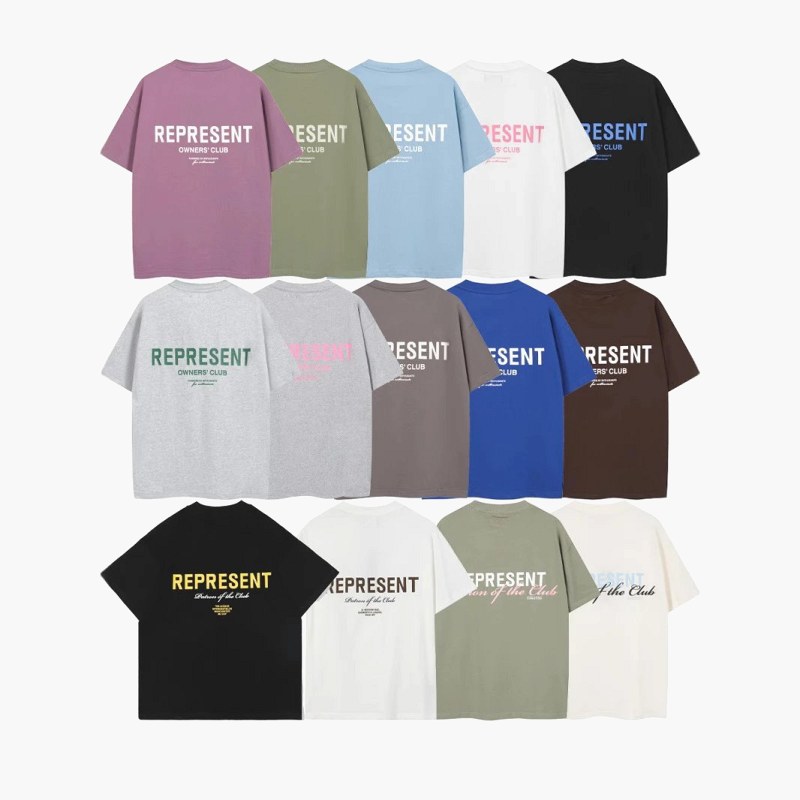
The product is a pullover crew neck in combed cotton jersey, short sleeve, regular thickness, listed at 180–250 gsm and aimed at summer and casual wear. Sizes run S–XL. The colour field is the awkward part: dozens of codes rather than a tidy six-colour palette, mixing plain wordmark colourways (black, white, blue, green, light blue, pink) with coded graphic variants such as R447, R3021, R3013 and REP211–REP249. Price at the time of our order was $7.76 against a $9.26 original, stock marked available.
Nothing on the listing page tells a first-time buyer which code maps to which print. The images do, but only if you open them in order and count. We did that before writing the note, and the count is where most of our preparation time went.
The five-line agent note, and what each line returned
| Line in the note | What we asked for | Did it earn its place? |
|---|---|---|
| 1. Variant and size | Exact code plus size, spelled out, not "black tee" | Yes — the only line that prevents a wrong-unit order |
| 2. Flat measurements | Chest, length, shoulder, paid measurement service | Yes — warehouse numbers landed within 1 cm of ours |
| 3. Print photo | One straight-on front shot with a white sheet for colour reference | Yes — the only way to judge a grey-brown tone under warehouse light |
| 4. Packing rule | No vacuum compression, keep the tee flat | Partly — arrived in a plain poly mailer, folded, no hard crease |
| 5. "Handle as fragile" | Extra padding | No — added nothing to a 226 g cotton tee |
Line five was a beginner reflex. A cotton jersey tee in a poly mailer is fine; the padding request only adds bulk to a consolidation and, on a volumetric line, could cost more than the garment. We would drop it next time and keep the measurement and photo lines, which together cost less than a coffee.
On the bench: tape, calipers, scale
We photographed both mailers before opening and weighed the garments on their own. For reference, the listing gives no per-unit weight, so these numbers are ours.
| Measured flat | Size S (black) | Size M (grey-brown) |
|---|---|---|
| Weight | 208 g | 226 g |
| Body length, shoulder to hem | 68.5 cm | 71.0 cm |
| Chest, pit to pit | 54.0 cm | 56.5 cm |
| Shoulder, seam to seam | 50.0 cm | 52.0 cm |
| Hem width | 54.5 cm | 57.0 cm |
| Collar rib width | 2.2 cm | 2.3 cm |
Both units sit inside the 180–250 gsm band the seller claims; 208 g and 226 g over these surface areas is consistent with a mid-weight jersey rather than the heavy 250 gsm end. The cut is loose, not aggressively oversized. A 54 cm pit-to-pit on an S is roomy for a small and explains why the community advice to size down exists at all.
One wash at 30 °C, then re-measured
- S: length −1.1 cm, chest −0.6 cm
- M: length −1.2 cm, chest −0.5 cm
- Collar rib unchanged at 2.2 and 2.3 cm; no waviness at the neckline
- Line dried in shade, no tumble drying — the care guidance the brand publishes for its tees
Under 1.5 cm of length loss on a cotton jersey is ordinary and does not change the fit. The collar was the pleasant surprise and the print was not: see below.
Warehouse photos against the delivered tee
We compared the warehouse image set with the parcel, marking every mismatch rather than only the big ones.
- Colour. The R447 grey-brown read warmer and more olive under warehouse fluorescent light than it does at home. A rephoto next to white paper settled it; the delivered garment matched our daylight assessment, not the first photo.
- Print placement. Front wordmark sat within roughly 3 mm of the warehouse photo on both units, measured off the collar seam.
- Seams. Side seams straight, hem level, no skipped stitching found on either tee.
- Count. Two units ordered, two received, correct codes on both.
That is a clean QC pass with one lighting caveat, and it is the reason we now ask for a white reference in the frame on every clothing order rather than arguing about hue after the parcel is abroad.
The print is the part with an expiry date
This is where the review stops being comfortable. Represent's own product copy for its Angel graphic tees carries the line "Each Piece Will Age Uniquely – Cracked Print May Lose Ink Over Time," and the same page elsewhere answers a print-fade question with "No, our graphics and prints are treated for longevity." Both statements are live on the brand's own pages, and we cannot resolve them from a $7.76 unit in two weeks.
What we can say is that a cracked-print graphic is designed to degrade, and the manufacturer has published a caveat saying so. Treat the print as a wear item, not a permanent feature.
Our two tees went through one cold wash with no visible ink loss. That is not evidence of longevity; it is evidence of one wash.
Sizing: still the open question
Buyers in Represent community threads describe the tees as roomy and several who wear a medium take a small. At least one reviewer who sized down found the result tight. Our S at 54 cm pit-to-pit is generous, but we are not going to convert a handful of conflicting reports into a rule. Use the measurement line in your order note, compare the returned numbers to a tee you already own, and let that decide — not the label.
Ordering this without wasting the prep
Three habits carried this order: name the variant code explicitly instead of a colour word, pay for flat measurements so the sizing question gets answered before shipping, and ask for one colour-reference photo. Skip the fragile packaging upgrade. Then accept the print as something that will change with wear, because the brand says so on its own product page.